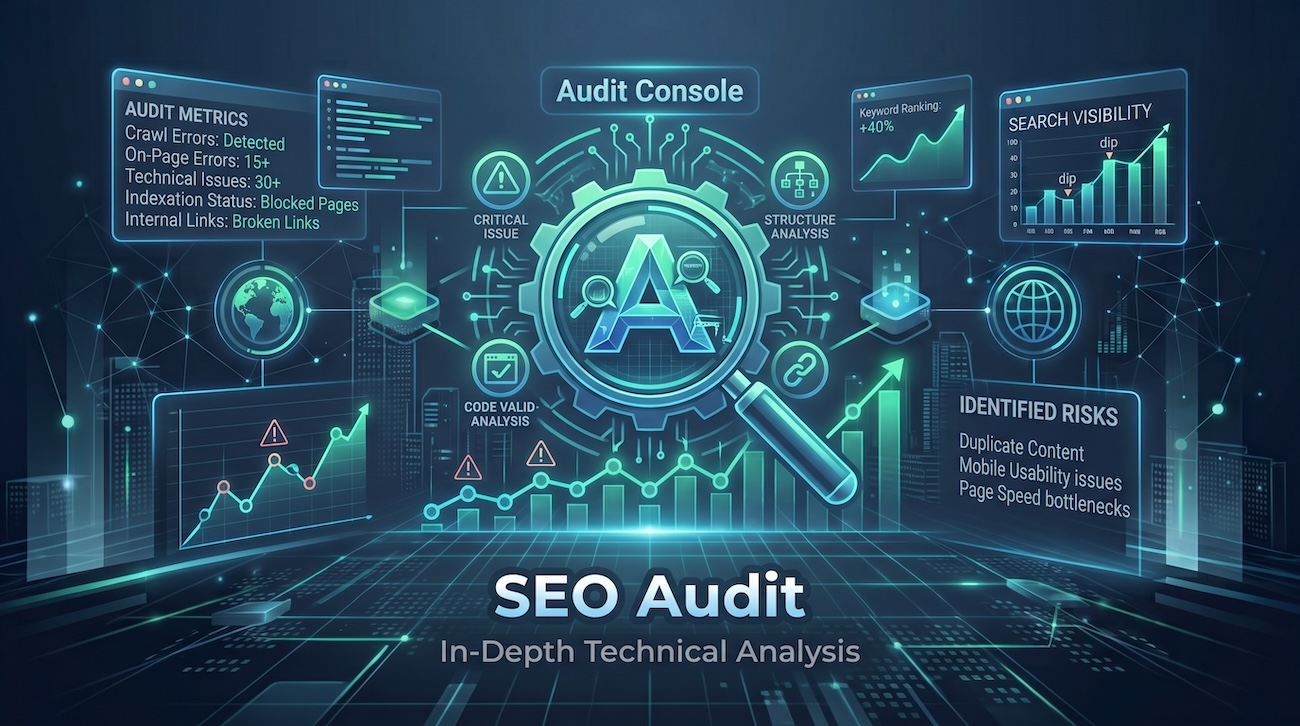
What "Expert SEO Audit" Actually Means in Saudi Arabia
Most audits sold in this market are the same 60-page PDF with your logo swapped in. A real audit tells you exactly why you are losing visibility to specific competitors in Riyadh, Jeddah, or Dammam — and what to fix first.
An SEO audit is not a scan. Automated tools can list broken links and missing meta tags in ninety seconds, and every agency in the region owns one of those tools. What separates a genuine audit is judgment: understanding how Saudi search behavior actually works across Arabic and English, how Google treats regulated industries under local advertising and financial rules, and how your specific competitors are winning the queries that matter to your revenue.
This audit is built around the Saudi market specifically — not a template translated from a US or European playbook. That means testing your site the way a buyer in Riyadh actually experiences it: on a mid-range Android phone, on mobile data, switching between Arabic and English, often arriving from a WhatsApp share or an Instagram bio link rather than a clean organic click. Very few audits test for that reality. This one does.
Saudi Arabia's digital economy has grown faster than most agency playbooks have kept up with. E-commerce spend, government digitization under Vision 2030, and a young, mobile-first population have changed how people search — and how quickly Google adjusts its ranking signals for the region. An audit written two or three years ago, or one copied from a market that doesn't share these dynamics, will confidently point you at the wrong priorities. This one is built for the market as it behaves right now, not as it behaved when most local SEO templates were first written.
The Gaps Most Audits in the Saudi Market Miss
Generic audits catch generic problems — duplicate titles, missing alt text, a slow homepage. Those matter, but they rarely explain why a competitor with a worse-looking site outranks you. The real gaps sit somewhere most checklists never look:
-
Overlooked
Arabic content built for readability, not for search intent
Modern Standard Arabic reads well but often ignores how people actually type queries — mixing dialect terms, transliterated English, and MSA in the same search session. Content written for elegance loses to content written for how Saudi users actually search.
-
Overlooked
No readiness check for AI Overviews and Arabic AI search
Google's AI-generated answers are already reshaping click-through rates in Saudi search results. Almost no local audit tests whether your content is structured to be extracted, quoted, and cited by AI Overviews — in Arabic specifically, where the pattern differs from English.
-
Overlooked
Core Web Vitals tested on the wrong network conditions
Testing on fibre in a Dubai office tells you nothing about how your site performs on STC or Mobily mobile data in Abha or Hail. Real-device, real-network testing regularly uncovers a completely different performance story.
-
Overlooked
E-E-A-T signals ignored for finance, legal, and health sites
If you operate in a YMYL category, Google holds you to a stricter trust bar — author credentials, licensing disclosures, verifiable business information. Most audits never check whether your site actually meets it under Saudi regulatory context.
-
Overlooked
Arabic/English versions competing against each other
Missing or broken hreflang between your Arabic and English pages means the two versions of your own site can cannibalize each other's rankings — a problem that shows up constantly in bilingual Saudi sites and is almost never diagnosed correctly.
-
Overlooked
Local signals scattered across cities
Inconsistent business listings, mismatched addresses, and thin Google Business Profiles across Riyadh, Jeddah, and Dammam quietly cap local visibility — even when the website itself is technically sound.
Sites that fix bilingual duplication and regional performance issues typically see measurable ranking movement within 60–90 days — long before any new content is published. The audit finds the leaks before you spend another riyal filling the bucket.
How the Audit Works
This isn't a single report dropped in your inbox. It's a structured process, and every step feeds directly into the next one.
-
Discovery and business alignment
A short working session to understand your actual revenue goals, target cities, and priority services — so the audit is scored against what matters to your business, not a generic scorecard.
-
Full technical crawl and Core Web Vitals diagnostics
Every indexable page is crawled and tested on real mobile conditions representative of the Saudi market, covering crawlability, site architecture, structured data, and page speed.
-
Content and topical authority review — Arabic and English
Both language versions are reviewed independently for search intent match, depth, AI Overview readiness, and internal duplication or cannibalization between them.
-
Off-page, local, and E-E-A-T signal audit
Backlink profile quality, Google Business Profile consistency across every operating city, and trust signals relevant to your industry are all checked against current Saudi ranking factors.
-
Competitor benchmarking
Your top five real competitors in the Saudi SERPs are analyzed side by side with your site — not generic "industry leaders," but the exact businesses currently outranking you for your priority terms.
-
Prioritized action roadmap
Every finding is scored by effort and expected impact, so you know exactly what to fix in week one versus what belongs in a quarterly plan.
What You Receive
The audit is designed to be used immediately — by your team, your developer, or by me directly if you move into ongoing SEO work afterward.
Bilingual audit report
Findings documented in both Arabic and English, written for decision-makers, not just developers.
Prioritized fix roadmap
Every issue ranked by effort and impact, so resources go to what moves rankings fastest.
Competitor gap analysis
A direct comparison against the five sites actually beating you in the Saudi SERPs today.
Keyword and topic opportunity map
Untapped Arabic and English search demand your current content isn't capturing.
Live walkthrough call
A recorded session going through the findings with you, not just a document you read alone.
30-day implementation checklist
The highest-impact fixes broken into a simple sequence your team can execute without guessing.
Audit Packages and Pricing
Pricing below is an approximate starting range for the Saudi market. Final scope and price depend on site size, number of languages, and industry complexity — confirmed on a short scoping call before any commitment.
| Package | Best for | Starting price |
|---|---|---|
| Starter Audit | Small business or single-location site, one language | SAR 2,500 |
| Growth Audit | Bilingual (AR/EN) sites competing across multiple Saudi cities | SAR 5,500 |
| Enterprise Audit | Large sites, regulated industries, or multi-brand portfolios | SAR 12,000+ |
Figures are indicative starting points, not final quotes. Every audit is scoped after a short discovery call.
Sites with heavy e-commerce catalogs, multi-branch service networks, or content in more than two languages usually land above the Enterprise starting point once the scoping call maps the real page count and technical footprint. You'll always see the final number before any work begins — nothing is billed against an estimate.
How to Choose the Right SEO Auditor
The Saudi market is full of "SEO audit" offers priced to sound irresistible. Most of them are automated reports with no human judgment behind them. Before you commit budget, run any auditor — including me — through this checklist.
-
Ask for a live sample audit, not a template screenshot
Anyone can show you a polished PDF. Ask them to open a real site — ideally a competitor of yours — and walk you through actual findings on a call.
-
Confirm they test in Arabic and English separately
If an auditor can't explain how they check for AR/EN duplication or hreflang issues, they are not testing your site the way it actually operates.
-
Ask how they evaluate AI Overview and GEO readiness
If the answer is a blank stare, the audit was written for search results as they looked two years ago, not as they look today.
-
Check for direct experience in your regulated sector
Finance, legal, health, and other YMYL categories carry a stricter trust bar. An auditor without sector experience will miss the signals that matter most.
-
Be wary of flat, ultra-low "100-point checklist" offers
A generic checklist priced to undercut everyone else is almost always a template with your domain name pasted at the top.
-
Ask what happens after the audit
A findings document with no path to implementation just sits in a folder. Ask whether the auditor can support execution, or hands the roadmap to your team clearly enough to act on alone.
Every audit above is run personally, not handed to a junior analyst following a template. Ten years across the UAE and Saudi markets means the findings are weighed against what has actually moved rankings for comparable businesses in this region — not a generic best-practices list that reads the same for a Riyadh clinic as it does for a New York law firm.
See exactly what's holding your rankings back
A scoping call takes fifteen minutes and tells you which package actually fits your site.
Book a scoping callReady to Dominate Search Results for Your Business?
Get a comprehensive architectural audit and an actionable organic roadmap to outrank competitors.