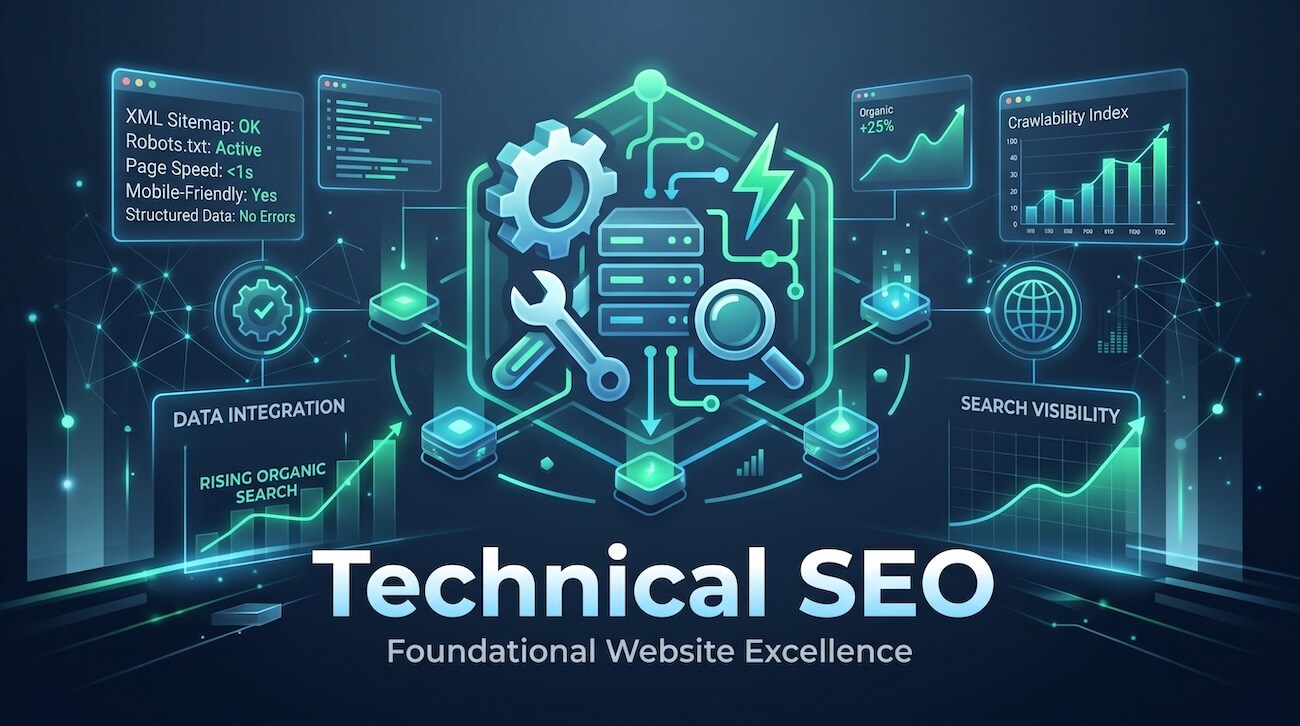
Enterprise Technical SEO: The Architectural Foundation for Search Dominance in the AI Era
In modern search landscapes, search engine optimization has decisively shifted from surface-level keyword insertion and loose backlink tactics into rigorous software engineering and infrastructure design. Advanced neural search systems—spearheaded by Google's Gemini models, MUM, and generative AI overviews—no longer evaluate web pages as static textual documents. They process web ecosystems as complex, dynamic client-server applications. If an enterprise website exhibits sluggish server response times, unrendered JavaScript bottlenecks, recursive parameter loops, or unmapped entity graphs, even the most exceptional marketing copy is rendered completely invisible to indexing crawlers.
Technical SEO constitutes the foundational infrastructure that dictates whether your digital platform possesses the technical capability to compete for Tier-1 commercial keywords or remains trapped beneath wasted crawl budgets and indexation drop-offs. This architectural guide provides technology executives, Chief Technology Officers (CTOs), lead engineers, and visionary founders with an authoritative, implementation-ready framework to audit, optimize, and fortify enterprise web systems for compounding organic market dominance.
The Six Core Pillars of Advanced Technical Architecture
1. Crawl Budget Engineering & Indexation Topology
Search engines assign every domain a finite allocation of server resources and crawler attention known as crawl budget. In enterprise and high-SKU e-commerce sites, up to 50% of this capacity is squandered on faceted filter matrices, non-canonical URL parameter permutations, session IDs, and tracking query strings.
- Eliminating Crawl Traps: Isolating redundant infinite parameter loops via granular robots directives and pristine canonical hierarchy tags.
- Dynamic XML Sitemap Partitioning: Splitting site URLs into segmented, lastmod-validated XML feeds to ensure critical revenue pages are crawled within minutes of deployment.
- Redirect Chain Dissolution: Systematically pruning historical 301 and 302 chains down to single-hop hops to prevent connection latency and crawler drop-off.
2. Server Log File Analysis & Real-Time Bot Auditing
While third-party SEO auditing suites provide external simulations, server access logs represent the ground truth of search engine crawler interactions. Log analysis reveals precisely what Googlebot accesses, ignores, and stumbles over in real time.
- Reverse DNS Verification: Authenticating genuine Googlebot User-Agents against spoofed scrapers that drain server CPU and I/O cycles.
- Orphan Page Discovery: Uncovering high-potential revenue pages that receive zero internal links and are completely bypassed by search engine crawlers.
- Response Code Heatmaps: Tracking micro-bursts of 5xx server exceptions and unhandled 4xx dead ends before they impact organic search rankings.
3. JavaScript SEO & Modern Framework Rendering
Applications built on modern frontend stacks like Next.js, React, Vue, Nuxt, or Angular operate within a dual-stage indexing queue. While raw HTML is parsed immediately, JavaScript execution is deferred until rendering cluster capacity becomes available.
- Server-Side Rendering (SSR) & Static Generation (SSG): Delivering pre-hydrated DOM structures to search engine crawlers without sacrificing interactive client states.
- Hydration Mismatch Mitigation: Preventing layout jumps and DOM destruction caused by discrepancies between server-rendered markup and client bundles.
- Static Anchor Enforcement: Ensuring internal discovery links are consistently served as valid `<a href>` DOM nodes rather than JavaScript onClick event handlers.
4. Sub-Second Core Web Vitals & Real-User Performance
Website speed is not an aesthetic luxury—it is an algorithmic ranking requirement and a direct driver of commercial conversion rates. Real-user field data aggregated by Chrome User Experience Reports (CrUX) directly impacts search rankings.
- LCP (Largest Contentful Paint) under 1.2s: Modern WebP/AVIF asset formatting, critical CSS inlining, font display swap rules, and aggressive preloading protocols.
- INP (Interaction to Next Paint) under 100ms: Deconstructing CPU-blocking Long Tasks and yielding the main JavaScript thread for immediate interaction responsiveness.
- CLS (Cumulative Layout Shift) below 0.01: Reserving explicit aspect-ratio geometry for images, banners, and third-party widgets to eradicate layout instability.
5. Interlinked Structured Data & Knowledge Graph Engineering
Semantic search algorithms parse websites via conceptual entities rather than isolated keyword frequencies. JSON-LD structured data acts as the formal machine-readable translation layer communicating your organization's verified domain authority.
- Nested Entity Architecture: Structuring unified graph nodes connecting Organization, WebSite, ProfessionalService, Author, and Article schemas.
- Rich Snippet Maximization: Implementing valid Product, AggregateRating, Offer, and BreadcrumbList schemas to capture dominant SERP real estate and lift CTR by 35%+.
- Knowledge Graph Authority Mapping: Leveraging exact `sameAs` entity URI references to Wikidata, Wikipedia, and verified corporate profiles to cement E-E-A-T credentials.
6. Multi-Regional Hreflang Architecture & Geotargeting
International platforms serving multi-lingual audiences across the GCC, Middle East, Europe, and North America face severe canonical fragmentation if localization tags are incorrectly configured or mathematically asymmetrical.
- Reciprocal Bi-directional Annotations: Enforcing strict 1-to-1 reciprocity across every regional URL permutation to eliminate orphan hreflang errors.
- Self-Referential & x-default Anchors: Seamlessly handling unmatched territories through standardized x-default routing gateways.
- Eradicating Forced IP Redirection: Ensuring search engine crawlers freely index local URL hierarchies without facing automatic regional geoblocking headers.
Deep-Dive: Resolving Complex Platform Architecture Bottlenecks
1. Resolving Faceted Search & Indexation Sprawl in E-Commerce
Modern commercial stores with thousands of product lines often generate millions of dynamic URL permutations via multi-select filters (color, size, brand, price range, and sorting orders). Unregulated crawler access to these parameter matrices rapidly exhausts server bandwidth, dilutes page authority, and produces catastrophic duplicate content loops.
Our Architectural Solution: We deploy a surgical triage strategy. First, we disallow low-value combinational parameters via robots directives while injecting canonical tags referencing the clean parent category. Second, we transition shallow user filters into client-side History API state updates without generating orphan query URLs. Third, we systematically construct dedicated, programmatic landing pages exclusively for high-volume commercial keyword entities.
2. Sub-200ms Server TTFB & Edge Infrastructure Optimization
Time to First Byte (TTFB) serves as the primary gateway for all downstream performance metrics. When an application server takes 800ms to 1500ms to assemble initial HTML responses, browsers cannot initiate font parsing, stylesheet execution, or asset preloading, triggering poor Core Web Vitals grades across the board.
Our Architectural Solution: We optimize database query execution plans, refactor expensive ORM relationships, implement in-memory Redis object caches, and configure Cloudflare Enterprise edge microcaching. By serving cached HTML documents from regional edge nodes located within milliseconds of regional users and crawlers, TTFB drops consistently below 180ms.
3. Internal PageRank Distribution & Silo Hierarchy Engineering
Flat website architectures frequently trap high-margin products and service sub-pages at a click depth of 5 to 7 tiers from the homepage. Search engine crawlers rarely explore past tier 3 on routine indexing passes, leaving high-value assets starved of authority and indexing frequency.
Our Architectural Solution: We engineer a strict Silo Topology combined with horizontal semantic linking. Crucial revenue pages are elevated to within 3 clicks of the root domain. Dynamic contextual cross-links, structured breadcrumb hierarchies, and topic cluster nodes ensure PageRank flows directly to the commercial landing pages that drive business revenue.
The 8-Phase Enterprise Technical SEO Methodology
We reject generic checklist exports and automated auditing scripts. Our consulting process treats your digital platform as an enterprise software system requiring deep forensic precision:
Server Log Extraction & Forensic Audit
Ingesting raw access log files across historical quarters to map authentic Googlebot traversal habits, crawl frequency distributions, and error anomalies.
Headless Chromium Crawl Simulation
Executing multi-threaded rendering crawls to inspect fully rendered DOM structures against raw server HTML responses to flag hydration deficits.
Core Web Vitals Profiling
Conducting laboratory and field audits across mobile user devices to dissect critical render paths, long task durations, and layout stability scores.
Canonical & Directive Optimization
Resolving duplicate protocol signals, trailing slash variants, staging site leaks, and configuring authoritative canonical hierarchies.
Schema Graph Engineering
Architecting interlinked JSON-LD structured data trees to establish corporate entity authority and unlock rich SERP features in Google search.
Crawl Resource Reconstruction
Streamlining robots.txt directives and automating dynamic, partitioned XML sitemaps to funnel crawler attention toward high-ROI assets.
Developer Ticket Specing (Jira Ready)
Translating technical audit findings into crystal-clear engineering tickets complete with code diffs, logic steps, and acceptance criteria.
Verification & Growth Measurement
Validating post-deployment server responses, tracking search console indexation rates, and quantifying compounding organic impression gains.
Approximate Investment & Service Pricing Architecture
Below is an indicative pricing table outlining our technical SEO consulting engagements, delivery timelines, scope parameters, and approximate investments for established platforms and ambitious enterprises:
| Engagement Tier | Core Scope & Deliverables | Estimated Timeline | Target Fit | Approximate Investment |
|---|---|---|---|---|
| Technical SEO Audit & Blueprint Forensic Architectural Diagnostic | Comprehensive server log inspection, crawl budget leak containment, canonical/redirect audits, DOM rendering validation, and Jira-ready engineering task tickets. | 10 - 14 Business Days | Mid-market Platforms & SaaS | $1,500 - $2,500 (~ 5,600 - 9,400 SAR) |
| Full Execution & Core Web Vitals Overhaul Hands-on Code & Infrastructure Tuning | Direct implementation pairing with development teams, Sub-second LCP/INP/CLS speed optimization, nested JSON-LD schema engineering, and JavaScript hydration fixes. | 3 - 5 Weeks | Enterprise E-Commerce & Booking Portals | $3,000 - $5,000 (~ 11,250 - 18,750 SAR) |
| Enterprise Retainer & Migration Defense Ongoing Technical Governance | Continuous 24/7 server log monitoring, site migration pre/post risk containment, staging deployment sign-offs, weekly CTO syncs, and proactive algorithm defense. | Monthly / Quarterly Retainer | Large-scale Scale-ups & High-traffic Portals | $2,200 - $4,500 /month (~ 8,250 - 16,800 SAR) |
Concrete Deliverables: Actionable Engineering, Zero Vague Theories
Clear architectural documentation containing precise code diffs and logic algorithms ready for developer sprint queues.
Direct log stream aggregations revealing daily crawler request frequencies, server status distributions, and latency bottlenecks.
Bespoke JSON-LD entity structures tested against Google Rich Results standards to capture prime SERP real estate.
Direct architectural consultations with your backend and frontend teams to review pull requests and resolve technical edge cases.
Strategic Engineering Commitment with Sameh Gamal
Technical SEO is not a superficial one-time checkbox; it is continuous digital civil engineering ensuring your online platform scales seamlessly through every algorithm update and product release. When partnering with Sameh Gamal, you do not receive recycled automated audit exports. You place your infrastructure under the stewardship of a veteran consultant who has engineered organic technical architectures for market-leading enterprise platforms, unlocking millions of recurring organic visits and millions in verifiable revenue.
Let us audit your server logs and source code today to architect an unshakeable organic technical advantage.
Ready to Dominate Search Results for Your Business?
Get a comprehensive architectural audit and an actionable organic roadmap to outrank competitors.